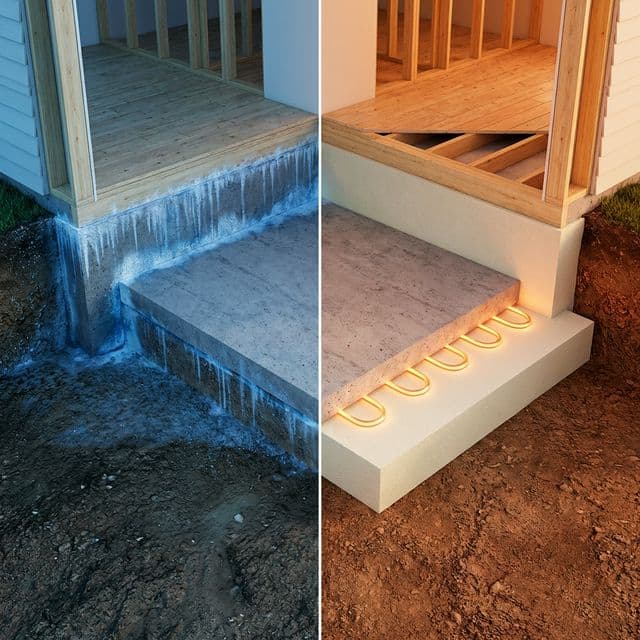
Why the Canadian Standard Survives Where Traditional Fails?
In southern Chile, moisture doesn't just fall from the sky; it rises from the ground. One of the most common problems in traditional construction (masonry or simple concrete) is rising damp (capillarity): water from the ground ascends through foundations and walls, generating mold, peeling paint, and a permanently cold thermal sensation in your feet.
The Failure of the Traditional System
The traditional concrete slab is usually built in direct contact with the ground, sometimes just over a gravel bed. Concrete is a porous material that, without an adequate barrier, acts like a sponge.
- Thermal Bridge: The cold from the ground is transmitted directly to the slab. If the ground is at 10°C, your floor will be close to that temperature, forcing you to spend more energy to heat the air.
- Rising Damp: In rainy areas or high water tables, moisture penetrates the structure, weakening it in the long term and affecting the health of the inhabitants.
The Canadian Solution: Perimeter and Slab Insulation
The standard we use at Canadian Houses cuts this thermal and moisture bridge at the root. We don't just worry about what is seen, but about what is in contact with the earth.
1. High-Resistance Moisture Barrier
Before pouring concrete, we install continuous and heat-sealed high-micron polyethylene barriers (minimum 0.2mm) under the entire surface of the foundation. This physically prevents water vapor or liquid moisture from touching the slab.
2. Under-Slab and Perimeter Insulation
This is the "secret" that few apply in Chile. We place high-density polystyrene (EPS) sheets under the slab and, crucially, on the exterior perimeter of the foundation.
- What does this achieve? It thermally decouples the house from the ground. The heat you generate inside your home doesn't "leak" into the cold earth.
- The result: You can walk barefoot in winter and feel a floor at room temperature, not a block of ice.
Technical Conclusion
Building in the south demands respecting the physics of materials. While the traditional system fights moisture with subsequent patches (coatings, waterproof paints), the Canadian Standard manages it from engineering and foundational design. It is the difference between a house that survives the winter and one that enjoys it.