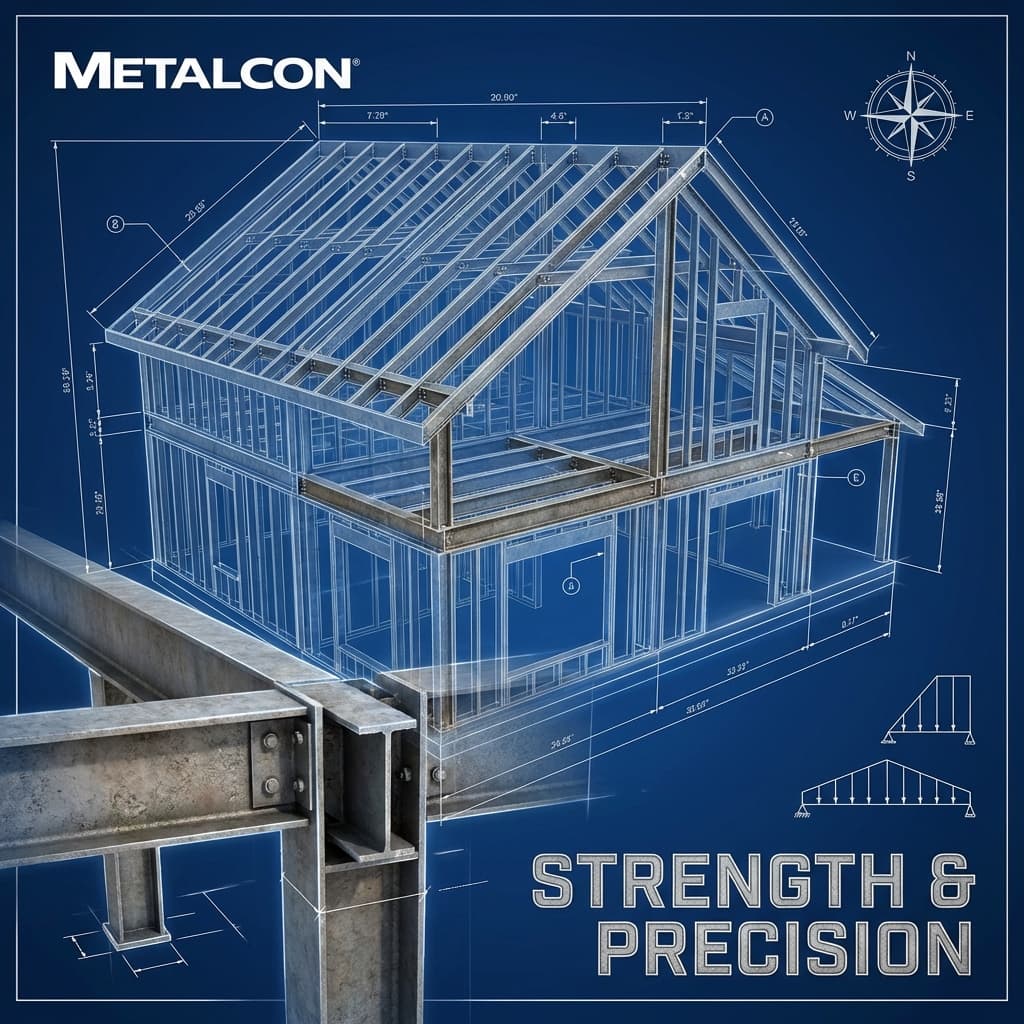
Why Metalcon Houses are Safest in Earthquakes
Chile is one of the most seismic countries in the world. When building, your #1 priority must be your family's safety. There is a myth that "solid" (reinforced concrete) is the safest, but modern engineering tells us otherwise.
The Physics of the Quake: F = m × a
Let's remember Newton: Force equals Mass times Acceleration.
In an earthquake, the earth accelerates your house. The more MASS (weight) your house has, the greater the FORCE the earthquake and inertia will exert on it.
- A concrete house is extremely heavy. It receives a brutal blow of energy.
- A Metalcon (light steel) house weighs a fraction. The seismic force it must resist is much smaller.
Ductility vs. Rigidity
Concrete and masonry are rigid but brittle materials. They tend to crack to dissipate energy. Steel, on the other hand, is a ductile material.
This means it can deform temporarily without breaking (elastic range). A Metalcon structure "dances" with the earthquake, absorbing kinetic energy and dissipating it without collapsing and, most importantly, without suffering serious structural damage.
Connections that don't fail
In the Canadian system, each profile is connected with high-strength self-drilling structural screws. There is no "mortar" that can detach. The house acts as a structural Faraday cage, a flexible monoblock that protects everything inside it.
Conclusion
You don't need 20cm concrete walls to be safe. You need smart engineering. Canadian houses have withstood the 2010 (Maule) and 2015 (Coquimbo) earthquakes with impeccable performance.
Build safe, build smart.